PayaSTEM

We established PayaSTEM in Hatay in 2015 as a STEM education and impact center to create equal opportunities in education, prepare young people for future careers, and contribute to social development through STEM. By combining academic development, technological production, and social responsibility, we aim to build a sustainable model for regional transformation.

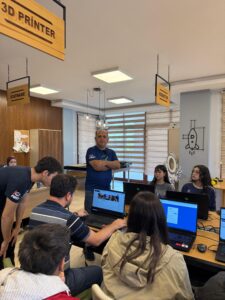
Our programs are built on mathematical modeling, scientific inquiry, computational thinking, and project-based learning. In our Artificial Intelligence classrooms, we provide hands-on training in robotics, Python programming, machine learning, data analysis, and computer vision, helping students develop analytical thinking and real-world problem-solving skills.

After the 2023 earthquakes, we turned PayaSTEM into an active part of the recovery process. We integrated 53 earthquake-affected students into our team and supported them with FRC training, helping them return to a structured learning environment. Today, these students organize weekly STEM workshops for children aged 5–10, sharing their knowledge with the community.

We also work to address social inequalities. In response to the low female workforce participation rate in Hatay, we created vocational training and skill-development workshops to support women’s employment and entrepreneurship.

Through the STEM education we provide at PayaSTEM, our Sparc-ing Young Minds program has reached 967 students, offering interdisciplinary training in scientific research, mathematical modeling, robotics, coding, and cybersecurity.

Today, we continue to develop PayaSTEM as more than an education center, a hub that expands access to knowledge, strengthens community solidarity, and empowers young people to build a better future.

With the 10-year “Japanese Embassy Technology Training for Women” program, we aim to provide vocational training to women and bring them into the business world. To date, 60 trainee women have been trained. Our target is 1800 women. In addition, in cooperation with Vodafone and Teknosa, we planned to provide cognitive awareness and 21st century skills to housewives. 50 female trainees have received technological and cognitive training so far and our target is 25,000 in Turkey. Since its establishment, PayaSTEM has been providing initial training in artificial intelligence in Python language to primary, middle and high school students in the quality of artificial intelligence education given worldwide. The number of students we can reach is 300. 

We were able to help 175 students in our project to introduce preschool students to STEM education and lay the foundations for interdisciplinary studies.